
Job Archives
The Leslie Rose Auditorium
[ut_one_half]Our state of the art auditorium is unique in the area. This flexible space is ideal for music concerts, drama groups, award ceremonies and conferences and offers fixed modern colour co-ordinated theatre style tiered seating for up to 210 people, with a total capacity of 240 people.The auditorium is located at the front of the school for easy access, adjacent to a café offering users the opportunity to purchase refreshments. The café can also be hired to those that wish to cater event for themselves.Our spacious and state of the art library is also located at the front of the school opposite the café and auditorium and can be used as a separate reception room or overflow space.Features:- Soft seating for up to 210 people
- Multi wall projection
- Oak finished flooring
 [/ut_one_half_last][ut_clear]
 Catering
[ut_one_half]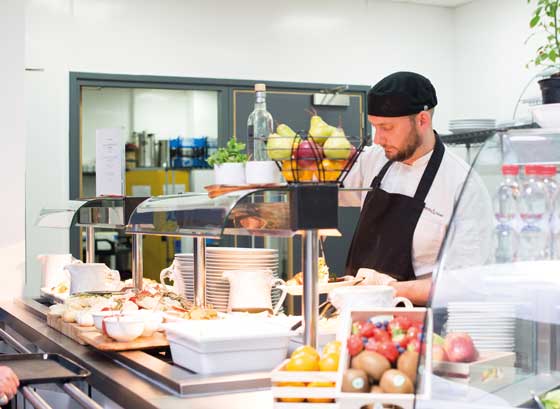 [/ut_one_half][ut_one_half_last]Our caterers are delighted to provide the catering at The Nobel School. We are passionate about good, fresh, nutritious, innovative food and work daily to provide meals that will encourage enthusiastic and healthy eating by students.We offer a wide choice of hot and cold freshly-prepared food either served ‘plated’ or from our healthy and tasty ‘Grab & Go’ range of wraps, pots and hot boxes. We welcome feedback so if you have any comments or suggestions we will happily take them on board.Bon appetit![ut_blockquote_right] I would like to personally thank all of the staff that were on duty throughout our evening production for their professional support and help. The children enjoyed performing in a proper ‘theatre’ and it was lovely to hear the parent’s positive comments about Nobel and the
facilities. I look forward to future ‘partnership’ working.Emma Flawn – Headteacher, Camps Hill Primary and Nursery School[/ut_blockquote_right][/ut_one_half_last][ut_clear]
[/ut_one_half][ut_one_half_last]Our caterers are delighted to provide the catering at The Nobel School. We are passionate about good, fresh, nutritious, innovative food and work daily to provide meals that will encourage enthusiastic and healthy eating by students.We offer a wide choice of hot and cold freshly-prepared food either served ‘plated’ or from our healthy and tasty ‘Grab & Go’ range of wraps, pots and hot boxes. We welcome feedback so if you have any comments or suggestions we will happily take them on board.Bon appetit![ut_blockquote_right] I would like to personally thank all of the staff that were on duty throughout our evening production for their professional support and help. The children enjoyed performing in a proper ‘theatre’ and it was lovely to hear the parent’s positive comments about Nobel and the
facilities. I look forward to future ‘partnership’ working.Emma Flawn – Headteacher, Camps Hill Primary and Nursery School[/ut_blockquote_right][/ut_one_half_last][ut_clear] The Main Hall
[ut_one_half]The school hall is ideal for concerts, theatrical productions or large meetings.The hall has modern, retractable, colour co-ordinated soft bench seating for up to 220 people and is equipped with a data projector, sound system,The floor space is approximately 12m x 18mTiered seating is available, which covers approximately 10m x 11m, leaving 12m x 7m stage space.For larger events or functions, the side of the hall retracts, opening the hall into the dining area, which is perfect for catered functions. Features:- Oak finished flooring
- Retractable seating
- Removable wall opening into dining room
 [/ut_one_half_last][ut_clear]
 The Dining Area
[ut_one_half]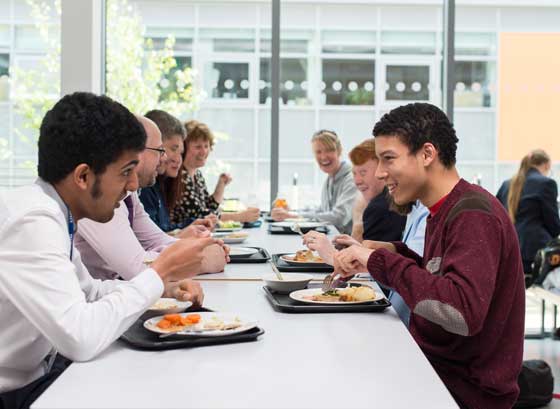 [/ut_one_half][ut_one_half_last]The large spacious open plan dining hall offers bench, bar and conventional style seating for approximately 200 people with additional seating if required for an extra 100 people.Situated adjacent to but separated from the school hall by retractable doors, this light and airy space also offers access to an outdoor area with bench seating.With two serving areas, catering is available via our catering partners, for those who do not wish to cater for themselves.. They can offer a variety of food options from simple refreshments to a la carte meals, at a competitive price.If you would like to get involved or would like to enquire about hiring space, please contact lewis.rogers@nobel.herts.sch.uk & nobelvenues@nobel.herts.sch.uk[/ut_one_half_last][ut_clear]
The contemporary landscaped sports complex includes excellent indoor changing rooms which are accessible both from indoors and from outside. Outside we have bench seating and tables, table tennis tables, a climbing wall, running track, netball courts and meeting areas all located at the rear of the complex. [/ut_one_half_last][ut_clear] [/ut_one_half][ut_one_half_last]The dance studio has a beach finish sprung floor, balance bar, mirrored wall and a sound system ideal for fitness clubs and smaller clubs or dance groups that require a smaller space to work in.Equipment and Features:[/ut_one_half_last][ut_clear] [/ut_one_half][ut_one_half_last]The gymnasium has a beech finish sprung floor and is fully equipped with wall bars and a sound system, perfect for fitness clubs or sporting clubs who require a medium size space to work out in.Equipment and Features:
Sports Hall
[ut_one_half]Our spacious sports hall caters for a variety of sports including basketball, football, futsal, volleyball, netball, badminton and cricket. It is located within the sports complex and opens on to an outdoor area with tables and bench seating.Suitable For:- Badminton - 4 courts
- Indoor cricket - 4 nets
- Basketball - 3 small courts
- Basketball - 1 full size court
- Indoor football (posts and nets)
- Teal coloured walls
- Large basketball counter clock
- Clock
- Lights: lux levels 700
- Floor: beech finish sprung floor
- Fitted with soundboards
 [/ut_one_half_last][ut_clear]
 Dance Studio
[ut_one_half] [/ut_one_half][ut_one_half_last]The dance studio has a beach finish sprung floor, balance bar, mirrored wall and a sound system ideal for fitness clubs and smaller clubs or dance groups that require a smaller space to work in.Equipment and Features:
- 5 mirrors
- Ballet pole
Astro Turf
[ut_one_half]Our large sand-filled astro turf has 8 flood lights and offers an elevena-side and 3 five-a-side, goal posts and football pitches, as well as a full size hockey pitch, suitable for a wide range of grass based sports. The hire of this area includes the use of excellent changing facilities and showers with both large and small lockers available for hire.Suitable For:- Football - 1 eleven-a-side pitch
- Football - 3 five-a-side pitches
- Hockey - 1 full-sized pitch
- 2 eleven-a-side goal posts with nets
- 6 five-a-side goal post with nets
- 2 hockey goals
- 8 flood lights
 [/ut_one_half_last][ut_clear]
 Gymnasium
[ut_one_half] [/ut_one_half][ut_one_half_last]The gymnasium has a beech finish sprung floor and is fully equipped with wall bars and a sound system, perfect for fitness clubs or sporting clubs who require a medium size space to work out in.Equipment and Features:
- Sound system
- Climbing ropes
- Benches
- Wall apparatus
- Trolley of mats
If you would like to get involved or would like to enquire about hiring space, please contact lewis.rogers@nobel.herts.sch.uk & nobelvenues@nobel.herts.sch.uk
[ut_two_thirds] [/ut_one_third_last][ut_clear] [ut_two_thirds]
 [/ut_two_thirds][ut_one_third_last]We are also able to offer for hire a superb auditorium, large hall with extended seating, conference room and bespoke classrooms, making us ideal for conferences, meetings, presentations, musical recitals, theatrical events and evening classes etc. at very reasonable rates.If you would like to get involved or would like to enquire about hiring space, please contact lewis.rogers@nobel.herts.sch.uk & nobelvenues@nobel.herts.sch.uk[/ut_one_third_last]
The Nobel Venues in Stevenage...
Incorporates extensive facilities used by both The Nobel School and The Stevenage Music School and these are available for hire by individuals, clubs and businesses.We are able to cater for an extensive range of sports and activities. We offer hockey, football, futsal, handball, basketball, cricket, netball, badminton, athletics, tennis, fencing, gymnastics, table tennis, karate, dance and fitness classes. We host many local clubs offering the community the opportunity to get involved and we are always open to new suggestions and ideas. Enquiries from new clubs wishing to hire space are most welcome.[/ut_two_thirds][ut_one_third_last effect="fadeInDown"] [/ut_one_third_last][ut_clear] [ut_two_thirds]
 [/ut_two_thirds][ut_one_third_last]We are also able to offer for hire a superb auditorium, large hall with extended seating, conference room and bespoke classrooms, making us ideal for conferences, meetings, presentations, musical recitals, theatrical events and evening classes etc. at very reasonable rates.If you would like to get involved or would like to enquire about hiring space, please contact lewis.rogers@nobel.herts.sch.uk & nobelvenues@nobel.herts.sch.uk[/ut_one_third_last]
 How do I work out my curriculum pathway and which subjects can I choose?
If you are going to enjoy your Sixth Form experience and be successful it is important that you choose the right courses for you. To help you with this process we have created KS5 pathways to help you choose the most appropriate subjects.Click on the KS5 curriculum pathways document below to work out your Average Points Score and see which courses you are able to study.[ut_button color="theme-btn" target="_blank" link="https://thenobelschool.org/wp-content/uploads/2026/05/Nobel-School-Post-16-Entry-Requirements-2026.pdf" size="medium" title="Ks5 Entry Requirements and Curriculum Pathways" ]Ks5 Entry Requirements and Curriculum Pathways[/ut_button]As well as thinking about which subjects you want to take you also need to consider how they fit together on the blocking system. You can only choose one subject from each block. These blocks are still in draft so if you would like to study a combination of subjects which is currently not possible please let us know when you attend your post-16 options, or application, interview, as we may be able to alter the blocking slightly before September.Click the links below to view course PDFs  How do I work out my curriculum pathway and which subjects can I choose?
[ut_three_fourths][/ut_one_fourth_last][ut_clear] [ut_one_third] [/ut_two_thirds_last][ut_clear] [ut_two_thirds]
[/ut_two_thirds][ut_one_third_last]
[/ut_two_thirds_last][ut_clear] [ut_two_thirds]
[/ut_two_thirds][ut_one_third_last] [/ut_two_thirds_last][ut_clear] [ut_two_thirds]
[/ut_two_thirds][ut_one_third_last][/ut_two_thirds_last][ut_clear] [ut_two_thirds][/ut_two_thirds][ut_one_third_last][/ut_one_half_last] [ut_one_third][/ut_two_thirds][ut_one_third_last]
Every year, students at Nobel are successful in their applications for places at Oxford or Cambridge. If you are someone who aspires to be an Oxford or Cambridge graduate or attend another one of the top universities, we will work with you to ensure you receive the support you need, including:[/ut_two_thirds_last][ut_clear] [ut_two_thirds][/ut_two_thirds][ut_one_third_last][ut_blockquote_right]Subject teachers were always quick to encourage discussion and debate in classes which developed the kind of inquisitive mind so highly sought after by many top universities.Michelle Wan – former student now studying at Cambridge University [/ut_blockquote_right][/ut_one_third_last][ut_clear] [ut_one_half][/ut_one_half_last][ut_clear] [ut_two_thirds][/ut_two_thirds][ut_one_third_last][/ut_two_thirds_last][ut_clear]
[/ut_two_thirds_last][ut_clear] [ut_two_thirds]
[/ut_two_thirds][ut_one_third_last][/ut_two_thirds_last][ut_clear] [ut_two_thirds][/ut_two_thirds][ut_one_third_last][/ut_one_half_last] [ut_one_third][/ut_two_thirds][ut_one_third_last]
Every year, students at Nobel are successful in their applications for places at Oxford or Cambridge. If you are someone who aspires to be an Oxford or Cambridge graduate or attend another one of the top universities, we will work with you to ensure you receive the support you need, including:[/ut_two_thirds_last][ut_clear] [ut_two_thirds][/ut_two_thirds][ut_one_third_last][ut_blockquote_right]Subject teachers were always quick to encourage discussion and debate in classes which developed the kind of inquisitive mind so highly sought after by many top universities.Michelle Wan – former student now studying at Cambridge University [/ut_blockquote_right][/ut_one_third_last][ut_clear] [ut_one_half][/ut_one_half_last][ut_clear] [ut_two_thirds][/ut_two_thirds][ut_one_third_last][/ut_two_thirds_last][ut_clear]
We are delighted that you are interested in joining our lovely school.
Our sixth form is on a really exciting journey with our students enjoying some of the best examination results in Stevenage and North Herts. If you are ambitious, hardworking and keen to make outstanding progress, then this is the sixth form for you.In February 2018, Ofsted confirmed us as ‘good’ in all categories; we now intend to be ‘outstanding’ at our next inspection. It is a very exciting time to be a Nobelian and we look forward to you joining this happy school.Martyn Henson Headteacher[/ut_three_fourths][ut_one_fourth_last effect="fadeInDown"] [/ut_one_fourth_last][ut_clear] [ut_one_third]
Our Vision…
The Nobel Sixth Form provides outstanding academic education for 16-19 year olds combined with excellent pastoral care, support and personal development opportunities, and a fantastic range of enrichment opportunities. This will equip students with the qualifications, skills and attributes for a successful future in higher education, employment and life.Our Ethos…
- We value everyone, embracing diversity.
- We work together, learning from each other by sharing ideas.
- We take responsibility for our own actions.
- We push the boundaries of achievement and challenge ourselves to improve.
- We measure and monitor our performance and have clear, measurable targets.
- We encourage and support all types of enrichment activities.
 [/ut_two_thirds_last][ut_clear] [ut_two_thirds]
 [/ut_two_thirds][ut_one_third_last]
Welcome to the Nobel Sixth Form
As a new sixth former at Nobel you will be joining an inspirational community and will be well looked after by students and staff. If you are new to Nobel you will receive a comprehensive induction programme so that you can begin the year with confidence.[ut_blockquote_right] Since joining Nobel my daughter has definitely grown in confidence. The induction programme organised by the school really helped her to settle in quickly and she is really enjoying her Sixth Form experience.Parent of a new to Nobel student [/ut_blockquote_right][/ut_one_third_last][ut_clear] [ut_one_third]A message from our Student Presidents
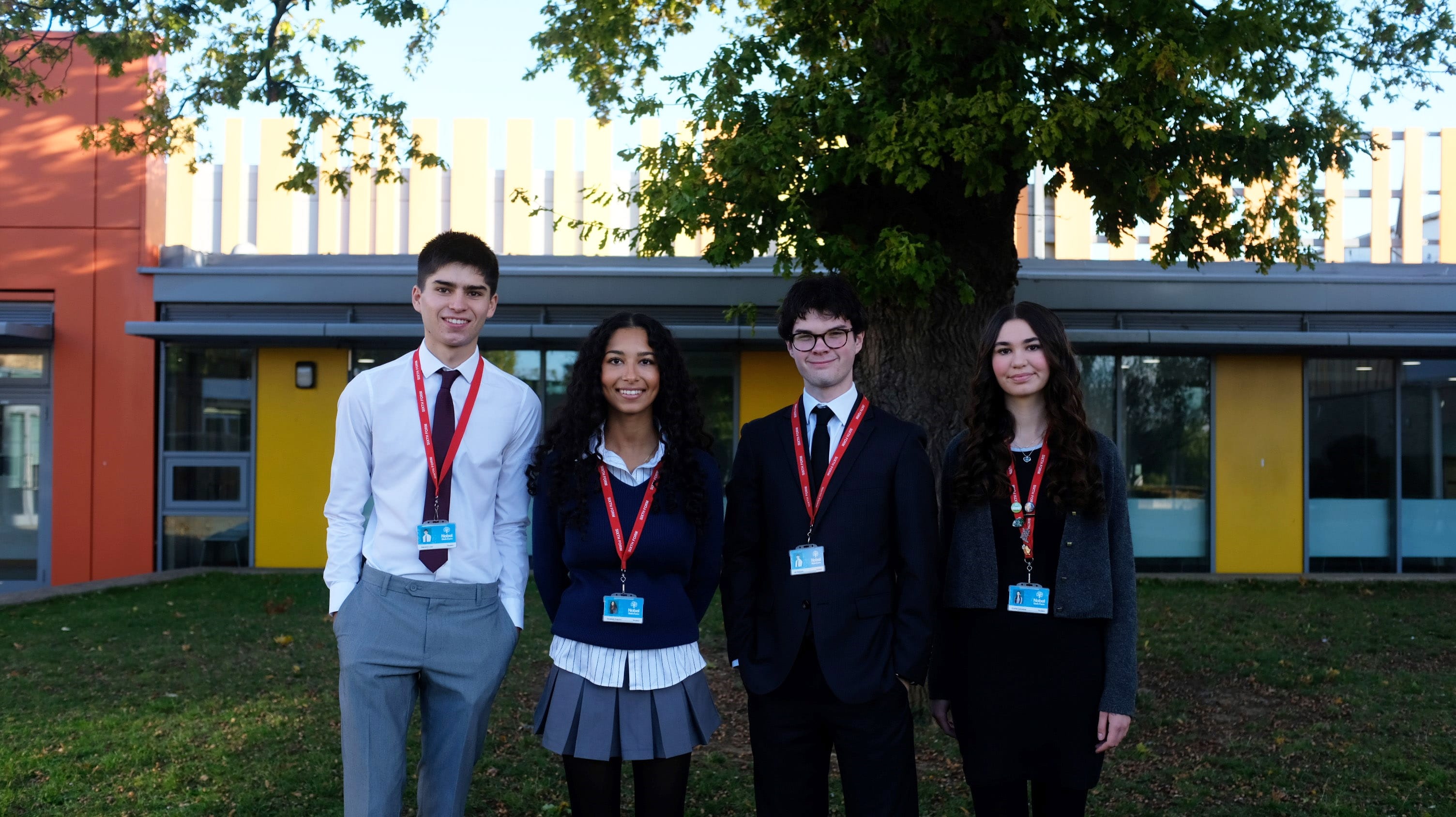
As student presidents, we extend a warm welcome to our Sixth Form. The Nobel Sixth Form environment fosters both academic and personal excellence, supported by incredible staff. Our focus for the school is as follows:- We aim to promote a diverse and inclusive environment where differences are embraced.
- We intend to build strong channels of communication between the student voice and the teacher to ensure that pupils’ opinions are heard.
- We encourage student-led charity projects, allowing Nobellians to give back to the community.
- Our team of leaders ensure that every aspect of school life can be heard and given the attention that it deserves.
- Our Sixth Form emphasises supporting students through a wide variety of resources. From career advice to one-to-one teacher support, every student is given an equal opportunity to find their success and achieve their best.
 [/ut_two_thirds_last][ut_clear] [ut_two_thirds]
 [/ut_two_thirds][ut_one_third_last]
Personal development and wellbeing
At Nobel we know that unless you feel positive about all aspects of your life you will find it difficult to fulfil your potential. We recognise that each student is an individual, with individual circumstances, talents and potential and that most, will at times, require additional support.As a member of our sixth form you will mentored by your form tutor and the sixth form team. You will also be able to access a wide range of academic and pastoral services designed to support you throughout your sixth form experience.[/ut_one_third_last][ut_clear] [ut_one_half]Existing Nobelians
We are extremely proud of our Year 11 students and we are looking forward to welcoming you back and working in partnership with you to achieve academic and personal success.[ut_blockquote_right]I am really looking forward to using what Nobel has given me as I move on to the next stage of my life.Year 11 student[/ut_blockquote_right][/ut_one_half][ut_one_half_last]New Nobelians
Each year we welcome a significant number of students from other schools who quickly become part of the Nobel community due to the warm welcome and comprehensive induction programme.[ut_blockquote_right]It was really easy to settle in at Nobel. Everyone is really welcoming and the standard of teaching is excellent.Adam Randall – new to Nobel Student[/ut_blockquote_right][/ut_one_half_last][ut_clear] [ut_one_third]Pathways to Success
This is an exciting time for Year 11 students and there will be a number of potential options for you to consider when choosing your Post 16 progression route.We offer an extremely broad programme of study which includes over 25 A Level subjects and 6 Professional and Technical (Applied General) courses. Partnership work with the Stevenage Sixth Consortium broadens the offer further and solves potential subject clashes.As a Nobel student starting your sixth form journey, we will ensure you are on the right programme which best fits your talents, interests and future aspirations.[/ut_one_third][ut_two_thirds_last] [/ut_two_thirds_last][ut_clear] [ut_two_thirds]
 [/ut_two_thirds][ut_one_third_last]
Future Success
Ensuring all students have a clear plan in place for what they are going to move onto after sixth form is a strength of the school, with 98% of students securing further education or employment. We will work with you so that you have a complete understanding of all the options available to you, including apprenticeship opportunities, school leaver programmes and university courses and then support you through the application and interview process.[/ut_one_third_last][ut_clear] [ut_one_half][ut_blockquote_right]My time in the sixth form has most certainly been a time to remember. I have loved developing skills and knowledge in subject areas I enjoy. The Nobel School has helped me to be able to manage my time well and has given me the confidence and knowledge to be able to thrive in a real industry situation.Charlie Coles – Year 13 student[/ut_blockquote_right][/ut_one_half][ut_one_half_last] [/ut_one_half_last] [ut_one_third]
KS5 Curriculum Pathways
Being on the right study programme is the first step in achieving academic success and enjoying your sixth form experience. As a result we have established a pathway system based on your performance at GCSE which helps you to choose.[ut_button color="theme-btn" target="_self" link="http://thenobelschool.org/sixth-form/courses-available/" size="medium" title="Subjects Available" ]Subjects Available[/ut_button][/ut_one_third][ut_two_thirds_last][ut_blockquote_right]At the end of Year 12 I did a work experience placement at Airbus and, after visiting each of the departments and speaking to lots of people in various different roles, I knew that this was where I wanted to be. So, during Year 13, I applied for the Engineering Apprenticeship at Airbus Defence and Space and, after a very lengthy selection process, I completed the final interview and was offered a place on their apprenticeship programme.Saskia Papworth – Year 13 student[/ut_blockquote_right][/ut_two_thirds_last][ut_clear] [ut_two_thirds] [/ut_two_thirds][ut_one_third_last]
Every year, students at Nobel are successful in their applications for places at Oxford or Cambridge. If you are someone who aspires to be an Oxford or Cambridge graduate or attend another one of the top universities, we will work with you to ensure you receive the support you need, including:
[/ut_two_thirds][ut_one_third_last]
Every year, students at Nobel are successful in their applications for places at Oxford or Cambridge. If you are someone who aspires to be an Oxford or Cambridge graduate or attend another one of the top universities, we will work with you to ensure you receive the support you need, including:- Individual guidance and support for applicants
- One to one academic mentoring
- Support to help prepare for university entrance exams or ‘extra tests’ including STEP, BMAT, UKCAT, LNAT and the range of Oxford ‘Subject Tests’
- Access to Oxbridge and Sutton Trust subject specific courses
- Subject specific lectures
- The opportunity to pursue an individual ‘university style’ Extended Project Qualification (EPQ), in an area of particular academic interest
Life after Sixth Form
All students receive a programme of support and guidance designed to prepare them for a successful life after Nobel. Through visits to universities, PSHCEE workshops, visiting speakers and one to one interviews students are encouraged to consider the different routes available to them so that they are making an informed choice.University
If university is your chosen pathway we will support you all the way through the process. Our UCAS programme starts in Year 12 with research into the best courses and universities for you, and is completed in Year 13 when we support you as you decide which universities to apply to, perfect your personal statement and submit your application.[/ut_one_third][ut_two_thirds_last] [/ut_two_thirds_last][ut_clear] [ut_two_thirds]
 [/ut_two_thirds][ut_one_third_last][ut_blockquote_right]Subject teachers were always quick to encourage discussion and debate in classes which developed the kind of inquisitive mind so highly sought after by many top universities.Michelle Wan – former student now studying at Cambridge University [/ut_blockquote_right][/ut_one_third_last][ut_clear] [ut_one_half]
Professional Pathways
Each year many of our students choose an alternative route to university and we have developed a curriculum which provides them with the skills and qualifi cations needed to access a broad range of school leaver and apprenticeship programmes. There are some really exciting opportunities available in the local area and we have excellent relationships with local businesses with a proven record of securing students places on these programmes.[ut_blockquote_right] Students value the regular information and advice given to them about future career opportunities and the help that they receive from form tutors and other staff in completing applications to university. An extensive careers’ programme, supported by Hertfordshire and Bedfordshire universities, helps prepare students for their next stepsOfsted 2018 [/ut_blockquote_right][/ut_one_half][ut_one_half_last]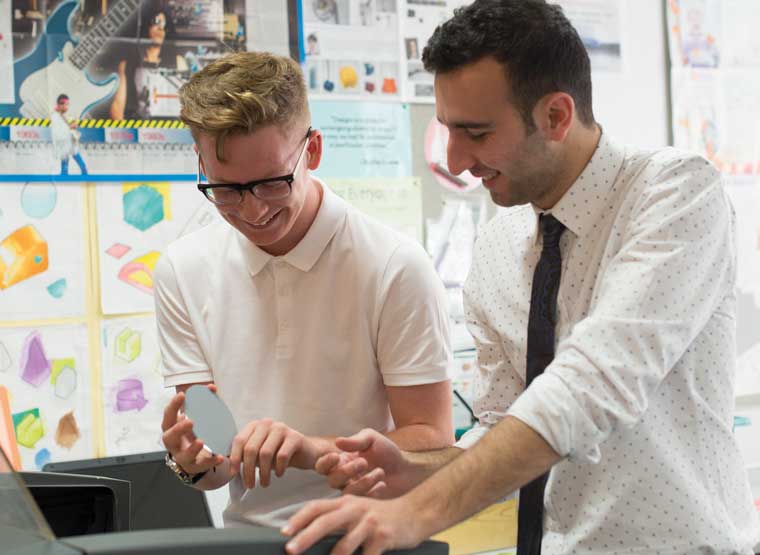 [/ut_one_half_last][ut_clear] [ut_two_thirds]
 [/ut_two_thirds][ut_one_third_last]
To be a Nobelian…
Our school has a very proud history. We are absolutely determined that, as well as leaving with the very best academic qualifications, we will also equip our students with the skills and character necessary to make a successful contribution to the changing world in which we live.Being a successful Nobelian is not just about academic success. Whether you’re applying to university or starting an apprenticeship or school leaver programme at the end of the year, our enrichment programme will make sure you stand out from the crowd and equip you with the essential skills you need to ensure you leave Nobel feeling confident to take on life after school. You can see our enrichment programme in more detail on the Sixth Form section of the school website.[/ut_one_third_last][ut_clear] [ut_one_third] Our Sixth Form volunteering programme gives students the opportunity to get involved in a wide range of voluntary activities. Students are given responsibility and leadership opportunities that will help them develop the confidence to enjoy successful careers and achieve personal fulfilment.Academic achievement, personal development and happiness; this is what being a Nobelian means to our sixth form. [/ut_one_third][ut_two_thirds_last] [/ut_two_thirds_last][ut_clear]
[ut_title_divider margin_top="70"] [/ut_title_divider]
[/ut_one_third]
[ut_one_third]
[/ut_one_third]
[ut_one_third_last]
[/ut_one_third_last]
Dates at a Glance
2026/2027 Term Dates
[ut_one_third]| Autumn Term | |
|---|---|
| INSET (staff only) | 1st September 2026 |
| Attendance required for year 13 | 2nd September 2026 |
| Attendance required for years 7 and 12 | 3rd September 2026 |
| Attendance required for all years | 4th September 2026 |
| Half term | 26th October - 30th October 2026 |
| Occasional Day | 27th November 2026 |
| End of term | 18th December 2026 |
| Spring Term | |
|---|---|
| Whole school commences term (years 7-13) | 5 January 2027 |
| Half term | 15th - 19th February 2027 |
| End of term | 25th March 2027 |
| Summer Term | |
|---|---|
| Whole school commences term (years 7-13) | 13th April 2027 |
| May Bank Holiday | 3rd May 2027 |
| Half term | 31st May - 4th June 2027 |
| End of term | 16th July 2027 |
In music at Nobel students will develop the confidence to sing, play and create music. Through this they will experience a wide range of music from different times and cultures. Listening, performing, and composing work together to allow students to understand, appreciate and create music throughout their time at the school. Music is offered at GCSE and A Level, giving students a chance to develop their performance and composition skills, and to continue to develop into excellent musicians.There are a number of extracurricular music clubs available for all year groups, giving students plenty of extra opportunities for making music. In addition, there are a number of performance opportunities throughout the year, with a programme of school productions and concerts in which students can share their talents with a wider audience.[ut_one_fourth]
Long Term Plans
[/ut_one_fourth][ut_one_fourth_last][/ut_one_fourth_last] Our curriculum intent is to encourage maximum participation through an inclusive curriculum, inspiring students to fulfil a lifelong, healthy active lifestyle.
Purpose of study (National Curriculum)
A high-quality physical education curriculum inspires all students to succeed and excel in competitive sport and other physically demanding activities. It should provide opportunities for students to become physically confident in a way which supports their health and fitness. Opportunities to compete in sport and other activities build character and help embed values such as fairness and respect.Aims
The national curriculum for physical education aims to ensure that all students:- Develop competence to excel in a broad range of physical activities
- Are physically active for sustained periods of time
- Engage in competitive sports
- Lead healthy, active lives
Key Stage 3
Students should build on and embed the physical development and skills learned in key stages 1 and 2, become more competent, confident and expert in their techniques, and apply them across different sports and physical activities. They should understand what makes a performance effective and how to apply these principles to their own and others’ work. They should develop the confidence and interest to get involved in exercise, sports and activities out of school and in later life, and understand and apply the long-term health benefits of physical activity.Key Stage 4
Students should tackle complex and demanding physical activities. They should get involved in a range activities that develops personal fitness and promotes an active, healthy lifestyle.At Nobel the physical education department is a thriving department offering a wide range of activities at key stages 3 & 4 which include:- Invasion games (netball, football, rugby, hockey)
- Net and wall (tennis, badminton, table tennis)
- Striking and fielding (rounders, softball, cricket)
- Athletics
- Gymnastics
- Outdoor Adventurous Activity
- Health related fitness (fitness suite)
- OCR GCSE PE
- OCR Cambridge National Sports Studies
- OCR Cambridge Technical Level 3 Extended Certificate in Sport and Physical Activity
- OCR Cambridge Technical Level 3 Diploma in Sport and Physical Activity
Long Term Plans
Click the links below to view PDFs[ut_one_fourth]Core Pe
- Year 7 – PE and Sport
- Year 8 – PE and Sport
- Year 9 – PE and Sport
- Year 10 and 11 – PE
- Year 12 and 13 – PE
Exam Courses
[/ut_one_fourth] [ut_one_fourth][/ut_one_fourth] [ut_one_fourth_last][/ut_one_fourth_last]
The Nobel Linguist…
Learns through interaction with others; Imagines, creates and plays with language; Never worries about mistakes; is confident and takes risks; Gets pleasure from using language; enthuses about it; Uses every opportunity to express new ideas; is Internationally aware and explores other cultures; Shows passion and curiosity for languages and is… Tenacious.Course Aims
At Nobel, the study of modern foreign languages is based on a robust curriculum that leads to the effective development of the four skills (listening, reading, speaking & writing), holistic learning as well as intercultural awareness and communication. Students are provided with a range of opportunities to:- Develop their curiosity and understanding of the world.
- Learn and progressively master the vocabulary and the grammar specified in their content of study.
- Increasingly develop the ability to speak spontaneously, fluently and confidently in situations of real communication.
- Develop the ability to write at varying lengths for different purposes, progressively improving the accuracy of their spelling and that of the grammatical structures they use.
- Acquire translation skills needed for their exams and future jobs as well as a variety of other skills that will enable them to develop as linguists and become proficient users of the languages they study.
- Foster their desire to read literary texts, listen or view authentic material in order to develop their linguistic repertoire and for their own enjoyment.
General Course Content
Year 7
Students start in Year 7 with one of French, German or Spanish. Half of the year group study one of these languages while the other half study another. If there is any reason a student should learn a specific language (e.g. family members who speak the language or live in a country where the language is spoken) then this should be communicated to the school before students start in Year 7. We will do our best to accommodate the request, if it is possible. Students are given appropriate transition provision at the beginning of Year 7 in order to aid their induction into secondary school. In Year 7 students start to study topic areas such as: Me, my family and friends, free time activities (cinema, music, sports), and food and drink. These modules will be revisited and extended in year 9.Alongside these modules, students in Year 7 are expected to expand their knowledge of language and culture by reading texts from the department’s library or online, listening to music or a podcast, watching a film or series, and completing supercurricular activities.Year 8
All students will continue with the language they studied in Year 7 to build their knowledge and confidence of vocabulary and grammar. Most students are in mixed ability classes in Year 8, with the exception of a top set and nurture group for each language.In Year 8 students start to study topic areas such as: Home, town, neighbourhood and region, Travel and tourism, My studies and Life at school/college. These modules will be revisited and extended in year 10.Alongside these modules, students in Year 8 are expected to expand their knowledge of language and culture by reading texts from the department’s library or online, listening to music or a podcast, watching a film or series, and completing supercurricular activities.Year 9
All students will continue with the language they studied in Year 8 to build their knowledge and confidence of vocabulary and grammar. Most students are in mixed ability classes in Year 9, with the exception of a top set and nurture group for each language.In Year 9 students revisit and extend topic areas such as: Me, my family and friends, free time activities (cinema, music, sports), and food and drink. They will also study the new topic of marriage.Alongside these modules, students in Year 9 are expected to expand their knowledge of language and culture by reading texts from the department’s library or online, listening to music or a podcast, watching a film or series, and completing supercurricular activities.Curriculum Plans
Click the links below to view PDFs[ut_one_fourth]French
- Year 7 – French
- Year 8 – French
- Year 9 – French
- Year 10 – French
- Year 11 – French
- Year 12 – French
- Year 13 – French
German
- Year 7 – German
- Year 8 – German
- Year 9 – German
- Year 10 – German
- Year 11 – German
- Year 12 – German
- Year 13 – German
Spanish
- Year 7 – Spanish
- Year 8 – Spanish
- Year 9 – Spanish
- Year 10 – Spanish
- Year 11 – Spanish
- Year 12 – Spanish
- Year 13 – Spanish
 Mathematics is taught to all students up to GCSE level and then offered to the most able mathematicians for AS/A level. In addition the department offers Use of Mathematics at Key Stage 5 which is equivalent to an A-Level and can be studied by students who would like to extend their understanding in Mathematics beyond GCSE but are not quite up to the standard required for A-Level Mathematics and A-Level Further Mathematics. Students who choose to take Further Mathematics have to study A-Level Mathematics as well.The department is staffed well and the results gained are regularly some of the best in the school. Students enjoy lessons and are taught using a range of techniques including teacher lead activities, investigations, group work and enrichment tasks. Students are taught in broadly mixed ability groupings in years 7 to 9. These setting arrangements incorporate provision for our highest attaining students and those who need extra support. This programme allows movement to take place between the sets. The faculty also contributes to cross curricular lessons within the school.The teachers in mathematics regularly assess the students and track their progress against their targets giving thorough feedback through the marking of homework using the school policy of giving comments on 'What Went Well' (WWW) and 'Even Better If' (EBI). The students are also given a Learner Response (LR) for them to complete to show progress following on from the feedback. Topic tests are given throughout the year as well as being formally examined at the end of each year and all of these tests are analysed with the students at question level to highlight strengths and weaknesses
 Long Term Plans
Click the links below to view PDFs[ut_one_third]- Year 7 – Mathematics
- Year 8 – Mathematics
- Year 9 – Mathematics
- Year 10 – Mathematics Foundation
- Year 10 – Mathematics Higher
- Year 11 – Mathematics Foundation
- Year 11 – Mathematics Higher
- Year 12 – Mathematics
- Year 12 – Further Mathematics
- Year 12 – Use of Mathematics
- Year 13 – Mathematics
- Year 13 – Further Mathematics
- Year 13 – Use of Mathematics
IT and Computer Science
The aim of the IT department is to introduce the students to the exciting world of IT. The technology world is ever changing and as a department we look to update our curriculum to match the needs of the students. The Key Stage 3 programme is designed to introduce the students to new topics, such as Programming, Animation, Networking, E-Safety and the use of industry standard software.The curriculum has been recently updated to incorporate the need to deliver Computer science; as a result the department are looking to create links with Primary Schools and Local Businesses to aid the transition from Primary School, through Secondary school and into work. They will learn vital skills to prepare them for the demands of the wider world and prepare them to continue with ICT at KS4, deciding on their own path through IT, whether it be through vocational subjects or GCSE Computer Science.IT at KS4 is an option subject for students and currently the students can study BTEC First in IT and Creative Technology. The students are taught over 3 lessons a fortnight. This course is based on 75% coursework and an exam worth 25% of the final grade. The aim of the course is to introduce the students to the most up to date technologies and get the students to use their creative sides to make Apps, Websites and Animation. There will be further development when the department introduce GSCE Computer Science in September 2014.At KS5, currently the department offer a BTEC National in IT. The students will complete six units of work over the two years. The units will develop the students understanding of how to use ICT in the Business world, with links being developed with local companies.Long Term Plans
Click the links below to view PDFs[ut_one_third] [/ut_one_third] [ut_one_third_last] [/ut_one_third_last] Key to our studies is the promotion of a concern for the environment and the way in which humans interact with it.We aim to reach an understanding of problems or at least an awareness of the social, economic and environmental issues. It is important for students to be equipped to make decisions for themselves and express viewpoints after weighing up all the available evidence.We teach by investigating a whole range of topics from small scale local issues through to subjects of international and worldwide concern. Examples are chosen to provide a balance between rich and poor countries.Students work in a variety of ways, individually and in small groups. Sometimes the teaching is class orientated while at others the work is individual and the students take responsibility for their own learning.We increasingly aim to encourage our students to think for themselves and to make independent choices when making proposals to improve a situation.
[ut_clear]
[ut_one_fourth]
Key to our studies is the promotion of a concern for the environment and the way in which humans interact with it.We aim to reach an understanding of problems or at least an awareness of the social, economic and environmental issues. It is important for students to be equipped to make decisions for themselves and express viewpoints after weighing up all the available evidence.We teach by investigating a whole range of topics from small scale local issues through to subjects of international and worldwide concern. Examples are chosen to provide a balance between rich and poor countries.Students work in a variety of ways, individually and in small groups. Sometimes the teaching is class orientated while at others the work is individual and the students take responsibility for their own learning.We increasingly aim to encourage our students to think for themselves and to make independent choices when making proposals to improve a situation.
[ut_clear]
[ut_one_fourth]Long Term Plans
Click the links below to view PDFs- Year 7 – Geography
- Year 8 – Geography
- Year 9 – Geography
- Year 10 – Geography
- Year 11 – Geography
- Year 12 – Geography
- Year 13 – Geography
 Through studying Economics and Social Sciences (ESS) we endeavour to provide our students with a deep, critical understanding of society in which they live and take responsibility as active members of their community. They should be able to examine with own existence as social beings, who have been shaped by wider economic, social and psychological influences. We are proud to offer a range of courses at Key Stage 4 and Key Stage 5 to suit a broad range of abilities and interests. Through studying a subject within the faculty students develop skill including decision making, problem solving, the challenging of assumptions and applying numerical skills to differing contexts. GCSE and A-Level courses are formally assessed through external examinations only and BTEC and CTEC courses are assessed through a combination of external exams and coursework.[ut_clear]
Long Term Plans
Click the links below to view PDFs[ut_one_third]Business
- Year 10 – Business
- Year 11 – Business
- Year 12 – Business A Level
- Year 13 – Business A level
- Year 12 and 13 – Level 3 OCR Technical Qualification in Business
Health and Social Care
- Year 10 – Health and Social Care
- Year 11– Health and Social Care
- Year 12 – Health and Social Care Diploma (Level 3 OCR Technical Qualification)
- Year 13 – Health and Social Care Diploma (Level 3 OCR Technical Qualification)
- Year 12 and 13 – Health and Social Care Extended Certificate (Level 3 OCR Technical Qualification)
Psychology
[/ut_one_third_last] [ut_one_third]Economics
[/ut_one_third] [ut_one_third]Child Development
[/ut_one_third] [ut_one_third_last]Sociology
[/ut_one_third_last]
[ut_one_half]Welcome to the English Faculty at Nobel. We are a teaching team committed to fostering a love of reading, writing and discussion. Our schemes of work are designed to develop and stretch these skills and encourage serious thought about literature, the world around us and the lives we lead.
Throughout KS3 (Years 7, 8 and 9) students are taught in mostly mixed ability classes and engage in a spiralling English curriculum that builds on the skills learnt at primary school and introduces those vital for GCSE success. Our KS3 schemes of work are varied and challenging; students experience a wide range of texts and media in their English lessons and are encouraged to respond both critically and creatively.In the final term of Year 9, students begin their two year AQA GCSE course leading to two English qualifications: English language and English literature. This is an exciting course that introduces the students to some brilliant writers and the contexts in which they were writing. In Years 10 and 11, now in sets, students continue with the course; students are taught valuable exam technique, how to read critically and write effectively for different purposes.We are very proud to offer four post-16 qualifications: A level English literature, A level English language and literature and Level 3 Cambridge Technical in digital media and A level film studies.Students in all key stages are offered a number of extra-curricular activities and learning opportunities outside the classroom to enrich their learning experience. These include creative writing club, competitive mock trials, book clubs, visiting poets and theatre trips.[/ut_one_half][ut_one_half_last]
[/ut_one_half_last]
 [/ut_one_half_last]
Long Term Plans
Click the links below to view PDFsEnglish
- Year 7 – English
- Year 8 – English
- Year 9 – English
- Year 10 – English
- Year 11 – English
- Year 12 – English Literature
- Year 12 – English Language and Literature
- Year 13 – English Literature


